



IAAA 2025 International Conference – Smart Space Access and Applications: Technological Breakthroughs for Agriculture & Urban Development in Vietnam
From July 16 to 18 at Vietnam National University of Agriculture (VNUA), the international conference “Smart Space Access and Applications” (IAAA 2025) attracted nearly 50 research institutions, universities, and technology experts from many countries such as Canada, the USA, Germany, Japan, South Korea, and more. The conference placed space technology at the core of current urgent issues: smart agriculture, connected urban areas, and climate change response.
Key topics presented at IAAA 2025 include: Hardware and spatial measurement; Smart space access and applications; Space communication and networks; Service quality management; Security and privacy assurance; Smart remote sensors.
Technological breakthroughs from the sky
In his opening speech, Dr. Nguyen Cong Tiep, Deputy Director of Vietnam National University of Agriculture, emphasized: “This year’s conference is especially notable for the participation of many renowned professors from leading universities and research institutes worldwide, who will deliver important keynote speeches, opening new research directions and collaborations. I believe that through this, we will create new partnership opportunities among research institutes, universities, enterprises, and international organizations.”
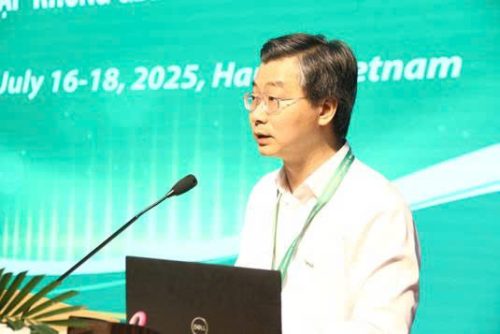 |
| Dr. Nguyen Cong Tiep – Deputy Director of Vietnam National University of Agriculture delivering the opening remarks. |
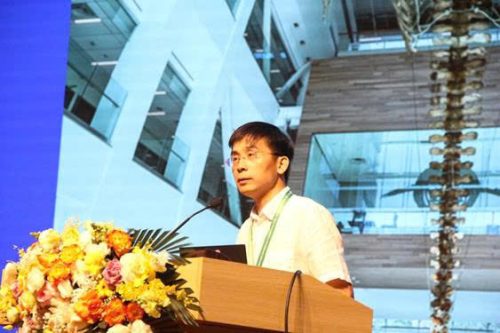
One of the most prominent topics discussed was a presentation by Professor Duong Quang Trung. Professor Trung, affiliated with Memorial University in Newfoundland (Canada) and Queen’s University Belfast (UK), is the first Vietnamese appointed as Editor-in-Chief of the prestigious IEEE Communications Surveys & Tutorials (IEEE COMST). With nearly 600 research works in telecommunications, computing, and 5G/6G networks, Professor Trung brought a comprehensive and in-depth perspective on three key fields: Quantum Computing; Machine Learning; and 6G Wireless Networks.
He discussed the application of hybrid quantum-classical machine learning to solve complex optimization problems in 6G networks. This hybrid model not only accelerates processing speed but also improves computational efficiency exponentially—crucial for low-latency, high-bandwidth, high-performance systems like 6G. The event was not only deeply specialized in the intersection of AI, quantum computing, and telecommunications but also a valuable opportunity for Hanoi University of Science and Technology students to interact directly with a leading expert. Professor Trung’s insights expanded knowledge and inspired young engineers to pursue cutting-edge science and foster creative thinking in the new technology era.
 |
|
Professor Duong Quang Trung – Memorial University (Canada) and Queen’s University Belfast (UK), IEEE journal Editor-in-Chief, presenting at the conference. |
Another highly engaging topic was a presentation by Dr. Tran Xuan Nam from Le Quy Don University, on UAV (drone) communication solutions. Acting as “flying base stations,” UAVs can extend communication networks to remote areas affected by disasters or agricultural zones requiring continuous data transmission.
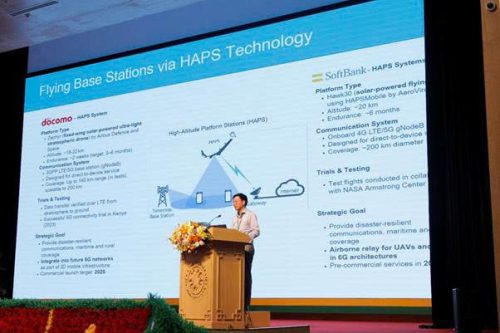
Dr. Tran Xuan Nam – Le Quy Don University, presenting at the conference
My T. Thai from the University of Florida, USA, discussed the topic: “Federated Learning”—a promising development or just an illusion?
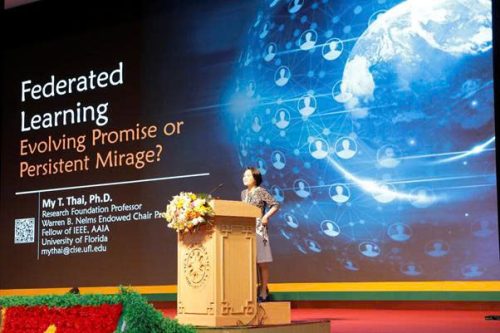
My T. Thai, Florida University, presenting at the conference
Gottfried Vossen from Münster University, Germany, presented on “When Artificial Intelligence (AI) Takes to Space.” GenAI (generative AI) has demonstrated transformative potential across many applications—from text generation and programming to image and video creation. Vossen analyzed how GenAI is stepping beyond traditional text and images to support disaster simulation, forest monitoring, and infrastructure planning. With real-time geographic data reconstruction, GenAI is predicted to become an extension of urban planners and environmental experts. Current models can enhance image resolution, fill missing data, optimize noisy data, and simulate real-world scenarios at local and global levels—opening new opportunities for environmental monitoring, disaster response, and infrastructure development. These capabilities are further amplified by Agentic AI and robotics progress. It’s no surprise that these powerful tools will soon expand into remote sensing, satellite platforms, and UAVs.
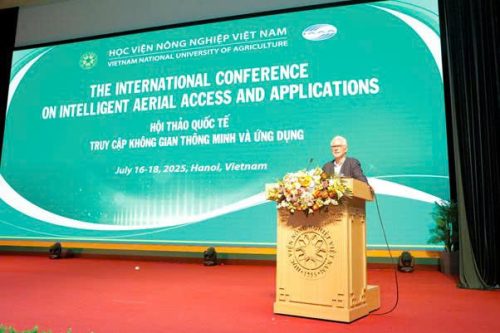
Gottfried Vossen – Münster University, Germany, presenting at the conference.
Sylvain Guilley from Secure-IC S.A.S., France, discussed “Security in Data Centers for AI Applications,” emphasizing that cybersecurity is crucial and requires the seamless integration of multiple technologies into data centers operating under tight data flow conditions.
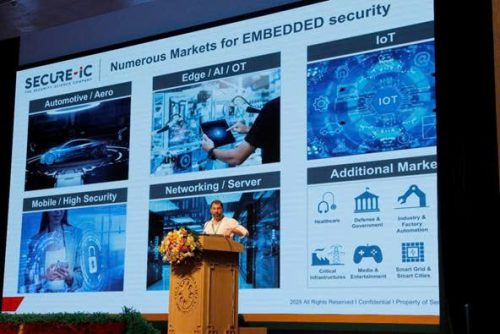
Sylvain Guilley – Secure-IC S.A.S., France, presenting at the conference.
Sensor technology also featured prominently in the discussion sessions. Professor Koichiro Ishibashi from the University of Electro-Communications, Japan, presented on: “Beat Sensors and Lightweight Data Encoding for High-Power, Long-Range IoT Sensors.” He introduced the Beat sensor—an ultra-low-power device that can wirelessly transmit data within a 2 km radius without batteries. This opens up applications across various fields: environmental monitoring, toxic gas leak detection, land management, and smart urban infrastructure operations.
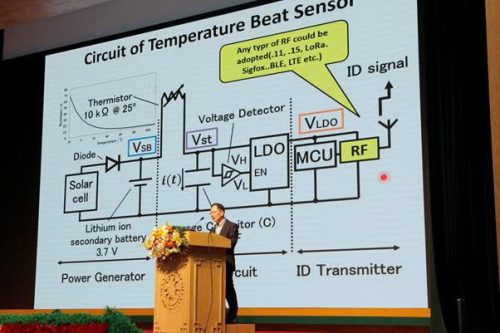
Koichiro Ishibashi – University of Electro-Communications, Japan, presenting at the conference.
Digital Solutions for Smart Agriculture and Urban Development
What makes the “Smart Space Access and Applications” 2025 international conference particularly special is not only its international scale but also its close relevance to Vietnam’s practical needs. Many advanced technologies, once considered “high-tech,” are now becoming effective tools for farmers managing rice crops, city planners, and authorities proactively managing natural disasters.
The lively conference atmosphere featured participation from agencies such as the Department of Digital Transformation (Ministry of Agriculture and Rural Development), the Ministry of Natural Resources and Environment, tech companies, lecturers, and hundreds of students from various universities.
Pham Quang Dung, Deputy Head of the Department of Information Technology, said: “The conference focuses on listening and exchanging advanced research and successful models. Experts and delegates also discuss new challenges and opportunities in applying AI to production, management, and supply chains, especially in the context of implementing Resolution No. 57-NQ/TW on breakthrough developments in science, technology, innovation, and the national digital transformation.”
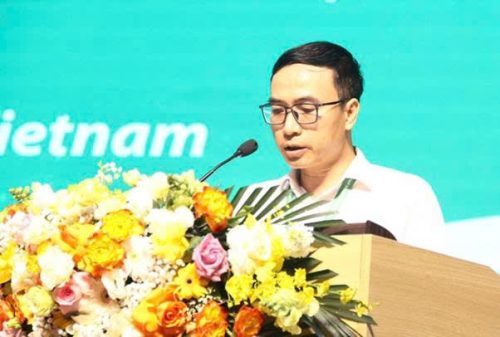
Pham Quang Dung – Deputy Head of the Department of Information Technology, speaking at the conference.
Main discussion topics include: spatial hardware and measurement; intelligent data access; remote sensors; data security; space communication networks; and service quality assurance. These are not just theoretical issues but directly address Vietnam’s current challenges: from data-scarce agriculture and flood-prone urban areas to increasingly severe natural disasters.
Many experts evaluate that the “Smart Space Access and Applications” 2025 international conference is an important stepping stone for Vietnam to soon master key technologies in its comprehensive digital transformation journey. When UAVs can “plant smart rice,” soil sensors detect pests and diseases, and satellite data assist farmers in planting at optimal times, technology is no longer exclusive to major powers.
| Học việnVietnam National University of Agriculture (formerly Vietnam University of Agriculture I), established on October 12, 1956, is a leading center for high-quality human resource training, multidisciplinary research, and technology transfer in Vietnam. The Department of Information Technology, founded in 2005 with 1 Associate Professor, 14 Doctorates, and 35 Masters trained at universities in advanced nations such as Japan, the UK, the US, Australia, France, Belgium, and the Netherlands, has now trained undergraduate and postgraduate students in Information Technology.
In 2017, the World Bank approved a US$54.2 million credit line to enhance research and teaching capacity at Vietnam National University of Agriculture. As a result, the university’s facilities are increasingly modernized to serve teaching and scientific research. In 2021, the university began recruiting and training students in Data Science and Artificial Intelligence for the first time. As a key national university, it aims to produce generations of graduates with international standards aligned with practical industry needs. Details about this program can be found at: https://tuyensinh.vnua.edu.vn/nganh-khoa-hoc-du-lieu-va-tri-tue-nhan-tao https://tuyensinh.vnua.edu.vn/nganh-khoa-hoc-du-lieu-va-tri-tue-nhan-tao |
Khoa Công nghệ thông tin


