History
On the 10th of October 2005 the Faculty of Information Technology (FITA) of Hanoi University of Agriculture (HUA) was officially established following the Decision No. 839/QĐ – NNI issued by the HUA Rector. There was, however, an IT undergraduate programme had started two years earlier (Decision no. 439/ QĐ/BGD&ĐT-ĐH issued by Minister of MOET, Ministry of Education & Training, on January the 1st, 2002).
Nowadays, there are approximately 70 staff and 600 students in FITA. The faculty is in charge of two undergraduate education programmes, namely Informatics and IT Management. There are 5 departments in the faculty: Software Engineering, Computer Science, Applied Maths & Informatics, Mathematics, and Physics. The latter two departments (Mathematics and Physics) were established at the same time with that of the University in 1956. The departments of Software Engineering and Computer Science have foundation from the former Centre of Informatics which was established in the beginning of 1980s.
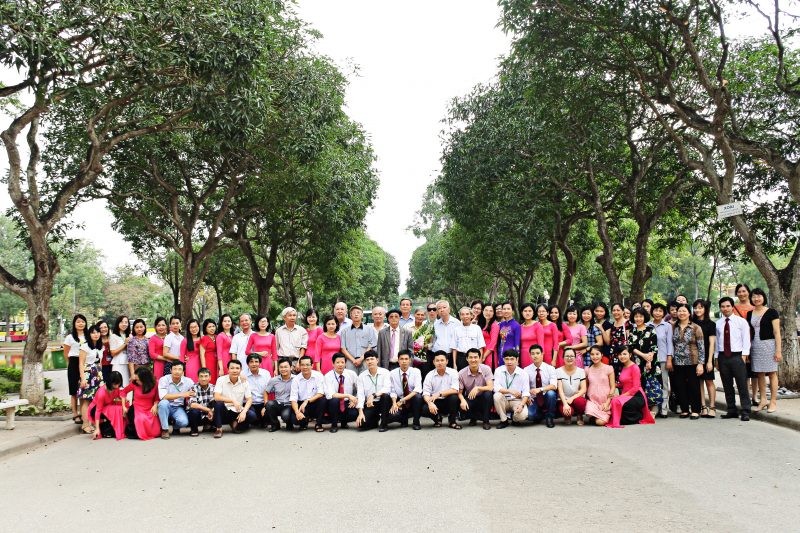
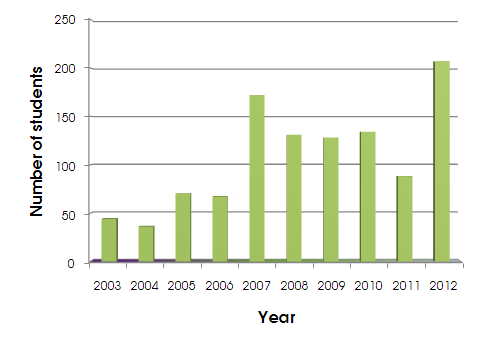
In recent years, although the number of students has not been increased, but quality of teaching staff has been improved remarkably considering number of staff who have Doctor/PhD degree. From 2011 to 2013 the number of Doctor/PhDs has been doubled to 10 persons. And in the same way, the number of publications by the FITA staff has been increased continuously as seen by the following Figure.
Research Activities of the Department
Scientific Research Achievements of Staff and Students:
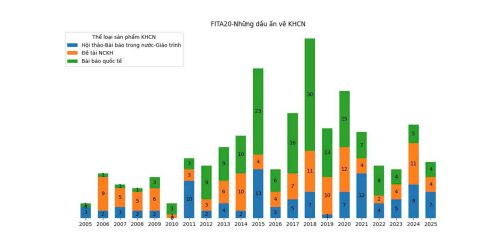
During the period from 2005 to 2025, the department’s faculty members have published nearly 300 scientific articles both domestically and internationally, many of which have been featured in prestigious global journals, demonstrating their dynamism and positive contributions to the international research community. At the same time, faculty and students in the department have undertaken numerous highly applicable research projects, contributing to the university’s scientific research activities: staff members have completed nearly 150 projects at various levels, helping to promote technological solutions in agriculture and rural development.
The student scientific research movement has been increasingly vibrant, with nearly 100 scientific research topics and creative ideas. Many of these projects have won high awards in student creativity contests and outstanding student projects organized by the academy, helping to cultivate an energetic, innovative young generation ready to meet the industry’s renewal demands.
Technological Products and Practical Applications:
Faculty members have developed many software applications to serve teaching and student management, such as the department’s student management system, automatic grading software, computer-based multiple-choice exam software, and other learning support systems, which have been widely adopted across the department and the academy. Additionally, many software products created by students have been received by businesses and the market, contributing to enhancing practical skills and digital transformation in the agricultural sector.
Conferences and Capacity Building Activities:
Over the past 20 years, from 2005 to 2025, the department has organized approximately 100 seminars at various levels, including one national-level and one international-level conference. Notably, the international conference “Smart Space Access and Applications – IAAA’2025” was successfully held in 2025, attracting over 200 delegates and leading scientists from nearly 50 domestic and international institutions. This event has elevated the department’s reputation, created opportunities for international cooperation and exchange, and affirmed its position in information technology and digital transformation fields.
Strong Research Groups and Digital Transformation Activities:
In 2018, the department established a strong research group called “Application of Information Technology in Agriculture,” which achieved initial successes and fostered the research spirit among its members, producing many applied products in agriculture. By 2025, the department established a new strong research group: “Big Data and Digital Transformation,” building on the previous group “Application of Information Technology in Agriculture,” bringing together highly specialized scientists and faculty members passionate about research, aiming to implement the Vietnamese Academy of Agriculture’s digital transformation tasks. The group focuses on researching methods for collecting, processing, and exploiting big data, developing AI, IoT, automation software, with the goal of developing sustainable, green agriculture aligned with the national digital transformation strategy.
International and Industry Collaboration
In terms of cooperation, the department signed several strategic collaboration agreements with leading universities worldwide, such as the University of L’Aquila and the University of Parma in Italy, in 2024. The scope of cooperation is diverse, including faculty, researcher, and student exchanges, joint research and project development, conferences, publications, and academic resource exchanges.
Domestically, the department maintains close collaboration with technology companies such as 1C, NIC…, to promote cooperation in student training, supporting internships and employment opportunities after graduation.
Promotion and Start-up Movements
Since 2023, under the assignment from the academy’s director, the department has actively organized recruitment promotion activities and startup journey seminars in Lao Cai and Ha Giang provinces. These activities have received high praise, contributing to enhancing the image and prestige of the academy and fostering a creative start-up movement among high school students.
The achievements of the Department of Information Technology over the past 20 years are clear evidence of the unity, creativity, and relentless efforts of all staff and students. We are proud of the past and confident in the future, continuing to contribute to building a modern, sustainable, and internationally integrated digital agricultural sector.
A chart illustrating the scientific and technological works of faculty members from 2005-2025
Number of new students yearly in FITA: